

Buying an off-plan property in Dubai allows purchasers to secure a home or investment before construction is completed, often through a payment plan spread across several instalments. However, missing a payment can raise serious questions about the buyer's rights, the developer's authority and the money already paid.
Can a developer cancel an off-plan property contract in Dubai simply because a buyer misses an instalment?
The answer is not immediately. Dubai's property regulations establish procedures that developers must follow before exercising their legal right to terminate an off-plan sale agreement.
A report published by Khaleej Times on 10 October 2026 highlighted the protections available to buyers who fall behind on their contractual payments. The report explained that developers cannot automatically cancel contracts and retain all payments without following the applicable legal process.
Understanding these rules is particularly important for buyers considering properties for sale in Dubai, including residential developments purchased during the construction stage.
What Happens If a Buyer Misses an Off-Plan Property Payment in Dubai?
When a buyer fails to pay an instalment under an off-plan Sale and Purchase Agreement (SPA), the developer may have grounds to begin a contractual default procedure.
However, the developer's rights are not unlimited.
Under Article 11 of Law No. 13 of 2008, as amended by Law No. 19 of 2020, developers must follow a regulated process involving the Dubai Land Department (DLD).
This means a missed instalment does not automatically result in the cancellation of the property contract.
The developer must first report the buyer's breach to DLD. The department then verifies the matter and, where the breach is established, issues the required notice to the purchaser.
The process is intended to provide an opportunity to resolve the outstanding payment or reach an agreement before termination measures proceed.
What Is the Legal Procedure for Cancelling an Off-Plan Property Contract?
The applicable legislation establishes several stages that must be completed before a developer can exercise the relevant statutory remedies.
1. Developer Notifies the Dubai Land Department
The first step requires the developer to notify DLD about the purchaser's failure to fulfil contractual obligations.
The notification must include information such as the buyer's and developer's details, the property involved and the obligations allegedly breached.
This gives the department an opportunity to assess the circumstances rather than allowing the developer to proceed solely on its own determination.
2. DLD Issues a 30-Day Notice to the Buyer
After verifying the contractual breach, DLD must serve the purchaser with a 30-day notice requiring the buyer to fulfil the outstanding obligations.
The notice must meet the legal requirements concerning its form and delivery.
During this period, the buyer has an opportunity to address the default, including by arranging payment or seeking an agreed resolution.
3. An Amicable Settlement May Be Considered
Where possible, DLD may facilitate an amicable settlement between the buyer and developer.
For example, the parties might agree to revise the payment schedule or establish another arrangement to resolve the outstanding obligations.
Any settlement reached through this process must be documented as an addendum to the original off-plan sale agreement and signed by both parties.
A developer is not automatically required to accept every proposed payment extension, but the statutory process provides an opportunity for settlement.
4. DLD Confirms Compliance and Construction Progress
If the notice period expires without the buyer fulfilling the obligations or reaching a settlement, DLD may issue an official document confirming the developer's compliance with the required procedure.
The document also addresses the project's construction completion percentage according to the applicable regulatory assessment.
This matters because the developer's available remedies and the amount that may be retained depend partly on the project's completion status.
5. Developer May Exercise the Applicable Legal Remedies
Once the statutory requirements have been met, the developer may be entitled to terminate the contract or pursue another remedy permitted by law.
The developer's rights are determined by the relevant circumstances and construction progress. They are not simply based on how much money the buyer has already paid.
The official Dubai Land Department termination of initial registration service provides information about the administrative process for developers seeking deregistration following buyer payment defaults.
How Much Money Can a Developer Keep After Off-Plan Property Cancellation?
One of the most important questions for buyers is whether they can recover the money paid towards the property.
Dubai law establishes different limits depending on the construction stage and the applicable circumstances.
The following table summarises the main provisions under the amended Article 11.
| Construction status | Developer's potential rights |
|---|---|
| More than 80% completed | May pursue specified remedies, including termination and retention of up to 40% of the agreed property price |
| 60%–80% completed | May terminate and retain up to 40% of the agreed property price |
| Construction commenced but less than 60% completed | May terminate and retain up to 25% of the agreed property price |
| Construction not commenced, or project cancelled by a final RERA decision | Buyer payments must be refunded under the applicable statutory procedures |
These are maximum statutory retention limits, not automatic penalties in every case. The applicable remedy depends on compliance with the law, the project's status and the circumstances of the default.
For projects exceeding 80% completion, the law also provides certain alternatives to termination, including pursuing the remaining purchase price or requesting a sale through DLD.
The detailed provisions appear in Dubai Law No. 19 of 2020.
Example: What Happens If a Buyer Defaults on an AED 2 Million Property?
Consider a buyer who purchases an off-plan apartment in Dubai for AED 2 million.
The buyer has already paid AED 800,000 through the agreed payment plan but later becomes unable to continue making instalments.
Assume the developer has completed 70% of the project and has satisfied the statutory requirements for termination.
Under the applicable provision, the developer may be entitled to retain up to 40% of the agreed property price.
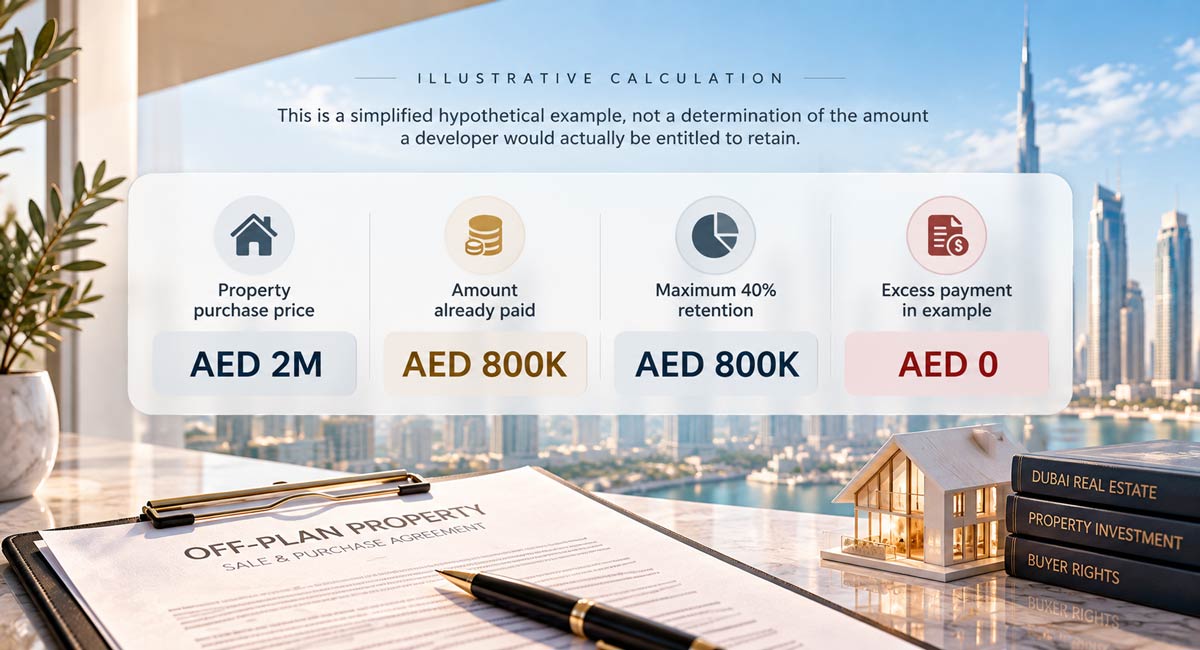
This is a simplified hypothetical example, not a determination of the amount a developer would actually be entitled to retain.
In this scenario, the statutory maximum retention equals the amount the buyer has already paid.
However, the developer's entitlement is not automatic. The applicable legal procedure must have been followed, and the actual outcome depends on the relevant facts.
If the buyer had paid AED 1 million instead, the difference between that amount and the illustrative AED 800,000 retention limit would be AED 200,000, potentially refundable according to the statutory requirements.
The law also provides specific deadlines for refunding excess payments following qualifying terminations.
This example demonstrates why buyers should understand the financial consequences of default before entering an off-plan property agreement.
Can a Developer Cancel an Off-Plan Contract Without Going to Court?
Under the applicable provisions of Article 11, a developer may exercise certain termination rights without first obtaining a court judgment or arbitration award, provided the statutory requirements have been satisfied.
However, this does not mean developers have unrestricted authority.
The buyer must have breached the contractual obligations, the required DLD procedure must be followed, and the developer's action must comply with the applicable law.
Importantly, buyers retain the right to challenge a developer's actions through the appropriate legal channels where there are grounds to do so.
A buyer who believes that a contract has been improperly terminated should seek advice from a qualified UAE property lawyer rather than assuming that the developer's decision is final.
What Happens If the Developer Delays or Cancels the Project?
A buyer's failure to make payments is different from a developer's failure to complete a project.
Where construction has not commenced for reasons beyond the developer's control and without negligence or omission on its part, or where RERA has cancelled a project through a final reasoned decision, the 2020 amendment provides for the refund of purchaser payments in accordance with the applicable escrow-account legislation.
However, a construction delay does not automatically mean that the buyer can cancel the contract and obtain a full refund.
The circumstances, contractual obligations, project status and applicable legal remedies must be examined individually.
Buyers concerned about construction delays should obtain official information about the development and seek professional legal advice before withholding payments.
What Should Buyers Check Before Signing an Off-Plan Sale Agreement?
Buying off-plan property can offer access to new developments and flexible payment structures. However, buyers should understand their financial commitments before signing.
The following considerations can help reduce the risk of future disputes.
Review the Payment Plan Carefully
Buyers should check the instalment schedule, payment deadlines and any amounts due during construction or at handover.
A payment plan that appears affordable initially may become difficult to maintain if income, financing arrangements or personal circumstances change.
Understand the Sale and Purchase Agreement
The SPA establishes important contractual obligations between the developer and purchaser.
Buyers should review provisions relating to payment defaults, construction milestones, completion dates, permitted changes, dispute resolution and termination.
Any unclear contractual terms should be reviewed before signing.
Verify the Developer and Project
Buyers should verify the development's registration, relevant approvals and available project information through the appropriate Dubai authorities.
Marketing materials and projected completion dates should not be the only basis for an investment decision.
Consider Additional Ownership Costs
The purchase price is not the only financial commitment.
Depending on the transaction, buyers may also need to account for registration fees, financing costs, service charges, maintenance and other expenses.
These costs should be included when assessing affordability and potential investment returns.
Compare Properties Before Committing
Buyers should compare location, developer reputation, project specifications, payment terms and market pricing before selecting a property.
Working with a knowledgeable real estate broker in Dubai can help buyers evaluate available property options and understand the differences between developments. Independent legal advice remains important for contractual matters.
What Should Buyers Do If They Cannot Make Their Next Instalment?
Financial circumstances can change during the construction period. Buyers who anticipate difficulties meeting an upcoming payment should act before the situation escalates.
Recommended steps include:
- Review the SPA and payment schedule. Identify the amount outstanding, due dates and relevant contractual provisions.
- Contact the developer promptly. Explain the situation and ask whether a revised payment arrangement may be considered.
- Keep written records. Maintain copies of payment receipts, notices, emails and any proposed settlement terms.
- Respond to official notices. Do not ignore communications from DLD or the developer.
- Obtain legal advice. A qualified UAE property lawyer can assess the agreement, applicable legislation and available options.
Early communication may help the parties reach an agreement, although an extension or settlement is not guaranteed.
Why Do Dubai's Off-Plan Property Cancellation Rules Matter to Investors?
Off-plan property purchases often involve financial commitments over several years.
For investors, the risk is not limited to whether the property's market value increases or decreases. It also includes the ability to maintain payments throughout construction.
An investor may purchase an apartment expecting to sell it before completion or finance the remaining balance at handover. However, resale opportunities, financing availability and market conditions can change.
A realistic investment strategy should therefore consider payment obligations even if the expected resale or financing arrangement does not materialise.
Investors comparing residential off-plan developments with commercial property for sale in Dubai should also recognise that each investment has different cash-flow requirements, risks and contractual considerations.
Understanding the consequences of missed payments is an essential part of evaluating an off-plan investment.
Frequently Asked Questions
Can a Dubai Developer Cancel an Off-Plan Property Contract After One Missed Payment?
A missed payment may constitute a contractual breach, but it does not automatically authorise immediate termination. Developers must follow the applicable legal procedures, including notification to DLD and the required notice process.
How Much Notice Must a Developer Give Before Cancelling an Off-Plan Contract?
Under Article 11, DLD must serve a 30-day notice on the purchaser after verifying the relevant contractual breach. This gives the buyer an opportunity to fulfil the outstanding obligations or reach a settlement.
Can a Developer Keep 40% of the Property Price?
In qualifying circumstances, the law allows developers to retain up to 40% of the agreed property price. The applicable maximum depends on the project's construction status and other legal requirements.
It is not an automatic deduction for every missed payment.
Can a Buyer Get a Refund After an Off-Plan Contract Is Cancelled?
A buyer may be entitled to a refund of amounts exceeding the applicable statutory retention limit. In certain circumstances involving projects that have not commenced or have been cancelled by RERA, different refund requirements apply.
The amount and timing depend on the applicable legal provisions and circumstances.
Can a Buyer Challenge an Off-Plan Property Cancellation?
Yes. Buyers may seek legal remedies where there are grounds to challenge a developer's actions, including alleged misuse of statutory termination powers.
Can Buyers Negotiate a New Payment Plan With the Developer?
Buyers may request revised payment arrangements, and an amicable settlement may be considered during the DLD process. However, developers are not automatically required to accept a proposed extension.
Any agreed changes should be properly documented.
Conclusion
Dubai's off-plan property cancellation rules establish important protections for both buyers and developers.
Although developers may have the legal right to terminate an agreement following a buyer's payment default, they cannot simply disregard the procedures established under Dubai property legislation.
The 30-day notice process, DLD involvement and construction-based retention limits are particularly important for purchasers to understand.
For buyers, the key lesson is to review the payment schedule carefully, understand the Sale and Purchase Agreement and maintain sufficient financial flexibility throughout the construction period.
Investors should also remember that off-plan property ownership involves contractual responsibilities in addition to potential investment opportunities.
Before entering a property transaction, buyers should verify the development, assess affordability and seek appropriate professional advice where necessary.
Disclaimer: This article provides general information about Dubai's off-plan property regulations and is not legal advice. The application of the law depends on the facts of each case. Readers should consult a qualified UAE legal professional for advice about an individual contract or dispute.




Join The Discussion